The DHL Hong Kong Air Trade Leading Index for Q4 2026 signals a resilient but uneven air-trade outlook: the overall index slipped to 40.6, imports strengthened to 42.9, and surveyed air traders expect peak-season volumes to be broadly stable. For Hong Kong-based DTC sellers, that is not a promise of cheaper air freight. It is a prompt to protect margins with flexible inventory, careful shipment planning and a clear view of landed costs as U.S. and European requirements change.
This guide explains what the Q4 figures do—and do not—say about air freight, why U.S.-bound and Europe-bound orders need separate cost and document plans, and how Hong Kong sellers can use local fulfilment and alternative routing without losing shipment visibility. The index is a forward-looking survey of air-trade sentiment, not a freight-rate forecast, so use it alongside your own carrier quotes, sales data and shipment-level costs.
What does the DHL Hong Kong Air Trade Index Q4 2026 say?
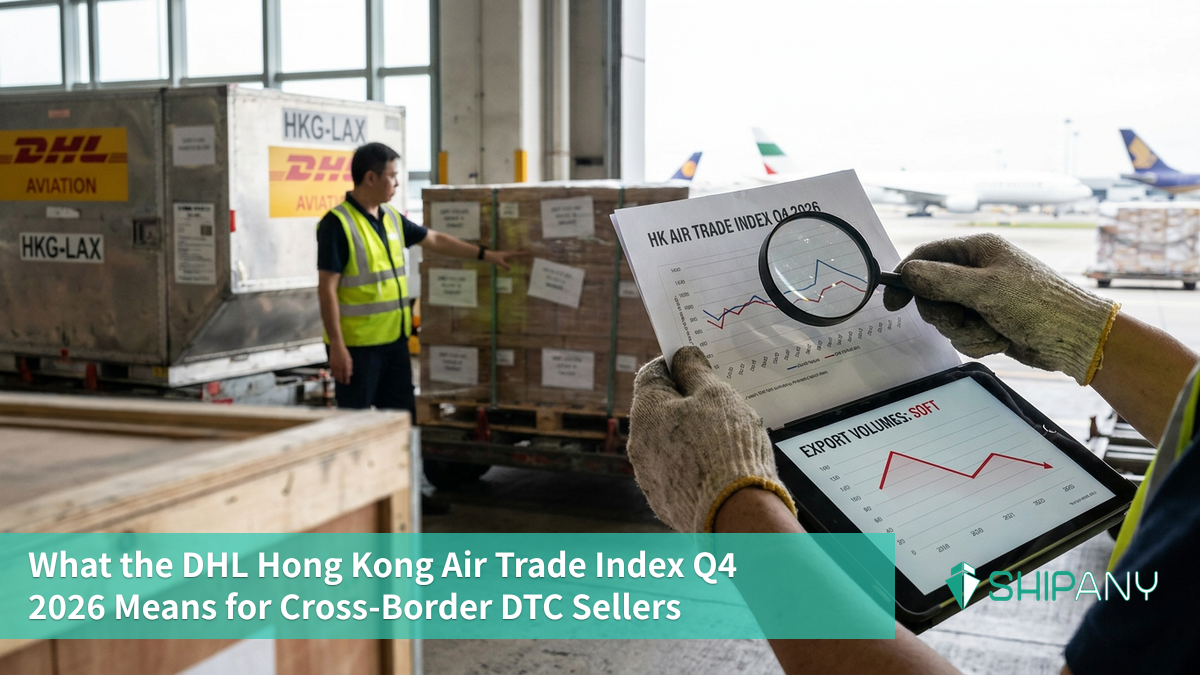
The Q4 2026 index points to steady overall activity, stronger air imports and a softer export outlook. Published on 12 October by the Hong Kong Productivity Council, the DHL Hong Kong Air Trade Leading Index fell 1.1 points quarter on quarter to 40.6. The Air Imports Index rose 3.8 points to 42.9, marking its third consecutive quarterly increase. The overall reading remained the second-highest in the past two years, but it is still below 50, the level that distinguishes a positive from a negative outlook in the survey.
That distinction matters for merchants. A higher import reading can reflect stronger inbound air-trade expectations; it does not tell an individual Hong Kong store that its supplier shipments will arrive faster or that outbound parcel rates will fall. Likewise, the overall index is not a measure of capacity, a guaranteed peak-season volume forecast or a price index. Treat it as a market signal: stay ready for demand, but do not build a margin plan around assumed rate reductions.
Market and product signals were mixed. Activity across Asia Pacific and Europe improved, while the Americas had the sharpest decline among the surveyed markets. Food and Beverage reached 52, a three-year high, and Electronic Products & Parts rose to 45, a two-year high. Apparel and clothing accessories, along with watches, clocks and jewellery, softened. If you sell into these categories, compare the survey direction with your own order patterns before changing stock or shipping commitments.
How should Hong Kong sellers prepare for U.S. policy and cost changes?
For U.S.-bound orders, build a shipment-level cost plan and check the current rules before dispatch rather than assuming last season’s economics still apply. The Q4 survey reports that, after new U.S. tariff measures introduced on 24 July 2026, respondents exporting to the Americas most often cited higher operating costs (22%), supply-chain adjustments (20%) and increased business uncertainty (20%) as expected impacts. These figures describe surveyed traders’ concerns; they are not a tariff rate or a prediction of your own costs.
For each product and order type, model the full landed cost: product cost, international transport, insurance where applicable, duties and taxes, brokerage or clearance charges, and the cost of handling exceptions or returns. Confirm the correct tariff classification, country-of-origin information, product description and declared value with a qualified customs or trade professional. Make sure the commercial invoice and other required shipment data agree. A low headline freight quote can be misleading if a missing or inconsistent detail causes a clearance hold or unexpected charge.
Keep a documented fallback for products whose U.S. margin is sensitive to policy or transport changes. That could mean reviewing selling prices, pausing a promotion until costs are confirmed, or allocating stock to other markets where you already have compliant demand. Do not reroute goods or change origin declarations simply to avoid a tariff: routing, origin and customs treatment are separate questions, and the paperwork must reflect the actual transaction and goods.
What should sellers shipping to Europe check about the planned B2C handling fee?
For Europe-bound DTC orders, verify the applicable fee, effective date and customs process for the destination before setting checkout prices or dispatching parcels. The Q4 survey discussed an EU-planned B2C handling fee for November 2026: over one-quarter of respondents exporting to Europe expected limited impact, while others anticipated pricing changes, additional customs and documentation work, and pressure on volumes and margins. The survey records expectations; confirm the current requirements with your carrier, customs broker or relevant official guidance for the specific shipment and destination.
Review how your store presents taxes and delivery charges, and decide who is responsible for import charges under your chosen shipping arrangement. Make that choice clear to customers before payment. If the customer may have to pay charges on delivery, explain that possibility and consider how it affects conversion, refused parcels and support workload. If you collect charges upfront, check that your shipping and checkout setup can transmit the required data accurately.
Prepare product and order information in a consistent format: precise item descriptions, values, quantities, origin details and any product-specific documents required for the destination. Keep a record of the assumptions used to calculate each market’s margin. When rules or carrier procedures change, you can then update the affected destinations and SKUs rather than applying a broad price increase to every order.
How can you manage air-freight volatility without sacrificing service?
Manage air-cost swings by separating urgent replenishment from predictable stock and evaluating the total delivery cost, not just the transport quote. For example, a Hong Kong skincare brand can use air for a small, fast-moving replenishment to meet a launch date, while planning less time-sensitive stock earlier and reviewing whether a different transport mode suits that inventory. A Hong Kong electronics seller may reserve faster service for high-value orders or urgent replacements, while consolidating routine replenishment where the product schedule allows.
Use your own shipment history to set practical triggers. Track chargeable weight, parcel dimensions, destination, service level, surcharges, clearance time, delivery performance and return costs. A packaging change that reduces volume can matter as much as a carrier change if pricing uses volumetric weight. Compare quotes for the actual package and destination, and rerun the comparison when a product, carton or shipping service changes. Avoid moving all volume to one route or provider based on a single low quote; capacity, transit time and service conditions can vary.
A multi-route plan should mean controlled options, not improvised transshipment. Decide in advance which eligible services, handoff points or fulfilment locations you can use, and check that each option supports the destination, goods and customs requirements. Keep the commercial invoice and tracking references aligned through any handoff. For Hong Kong sellers managing many orders, ShipAny’s Shipping calculator can help compare live shipping quotes, while its E-commerce delivery service brings quotes, waybills, pickup and tracking into a more connected store-shipping workflow.
How can Hong Kong fulfilment and routing give you more flexibility?
Use Hong Kong fulfilment to keep inventory close to your team and customers while deciding carefully which orders need international air dispatch. A local stock location can support domestic delivery, returns inspection, relabelling where permitted, and consolidation of international orders. For a seller operating from Kwun Tong or Tsuen Wan, a reliable local pickup schedule and accurate stock records can reduce the time between an online order and a correctly prepared export parcel. Local delivery is not a substitute for international transport, but it can make the fulfilment handoff more predictable.
Where your business and destination rules allow, compare direct shipment from Hong Kong with a planned regional fulfilment or consolidation option. Assess inventory carrying cost, handling fees, transfer time, duties, documentation and the effect on customer delivery promises. A regional location is not automatically cheaper: it may add a storage or handling step, and goods can have different customs treatment depending on their origin and movement. Confirm the full route and responsibilities before sending bulk stock away from Hong Kong.
Keep customers and staff informed with end-to-end tracking and clear exception handling. A multi-carrier setup is useful only if the order reference, label, customs data and tracking status remain connected across each handoff. ShipAny’s Hong Kong logistics services can support local courier, locker and pickup needs as part of a broader fulfilment plan. Pair local operations with a documented export workflow so that a delay or address issue does not turn into an untraceable parcel or a costly reshipment.
FAQ
Does the Q4 2026 index mean Hong Kong air-freight rates will rise?
No. The DHL Hong Kong Air Trade Leading Index measures surveyed traders’ forward-looking air-trade outlook, not freight prices. Use it as context and compare current quotes for your package, destination and service before setting prices or choosing a route.
What were the main Q4 2026 index figures?
The overall index fell 1.1 points to 40.6, while the Air Imports Index rose 3.8 points to 42.9. The overall reading remained the second-highest in the past two years, and the survey found mixed conditions across destination markets.
What should a Hong Kong DTC seller prepare for U.S.-bound shipments?
A Hong Kong seller should review current tariff and customs requirements for each product and destination, then calculate landed cost using the correct classification, origin, declared value and shipment details. Confirm documentation with a qualified trade or customs professional and do not assume a new route changes the goods’ origin or tariff treatment.
How can Hong Kong sellers protect margins on Europe-bound orders?
Check the current handling-fee and customs requirements for the destination, then make delivery-charge and import-charge responsibilities clear at checkout. Keep product descriptions, values and origin data consistent, and test the effect of fees, clearance work and possible refused deliveries on each product’s margin.
Conclusion
The Q4 2026 DTI is a signal to plan for resilience, not a reason to assume cheaper or easier shipping. Hong Kong DTC sellers can protect profit by checking destination rules, measuring true shipment costs, keeping fulfilment options flexible and maintaining accurate documents and tracking.
Use the index to frame the questions; use current quotes and your own order data to make the decisions. That combination gives you room to respond when demand, policy or air-shipping costs move.