Hong Kong online stores can protect delivery margins by checking current carrier charges, packing parcels to their true size and offering customers a choice of SF Express delivery and suitable pickup locations. The aim is not simply to pick the cheapest service: it is to match each order with a delivery option customers will use, at a fulfilment cost the business can sustain.
This guide explains how to review the charges that can change a shipment’s final cost, reduce unnecessary volumetric weight and assess SF Express lockers, stores and other pickup points alongside door delivery. It also outlines a practical way to compare delivery speed, customer convenience and operational effort before setting your checkout shipping mix.
How should Hong Kong stores review current delivery charges?
Start by checking the latest rate card and service terms for the exact parcel, service and payer arrangement you use. A headline base rate is not always the amount that appears on the invoice: fuel and remote-area surcharges, special handling, address corrections, redelivery or other service fees may apply. Confirm which services are available for your shipment and whether the quoted charge includes any add-ons. SF Express publishes Hong Kong service rate information, but rates and conditions can change, so use the current carrier materials or a live quote rather than an old spreadsheet or a price remembered from a previous campaign.
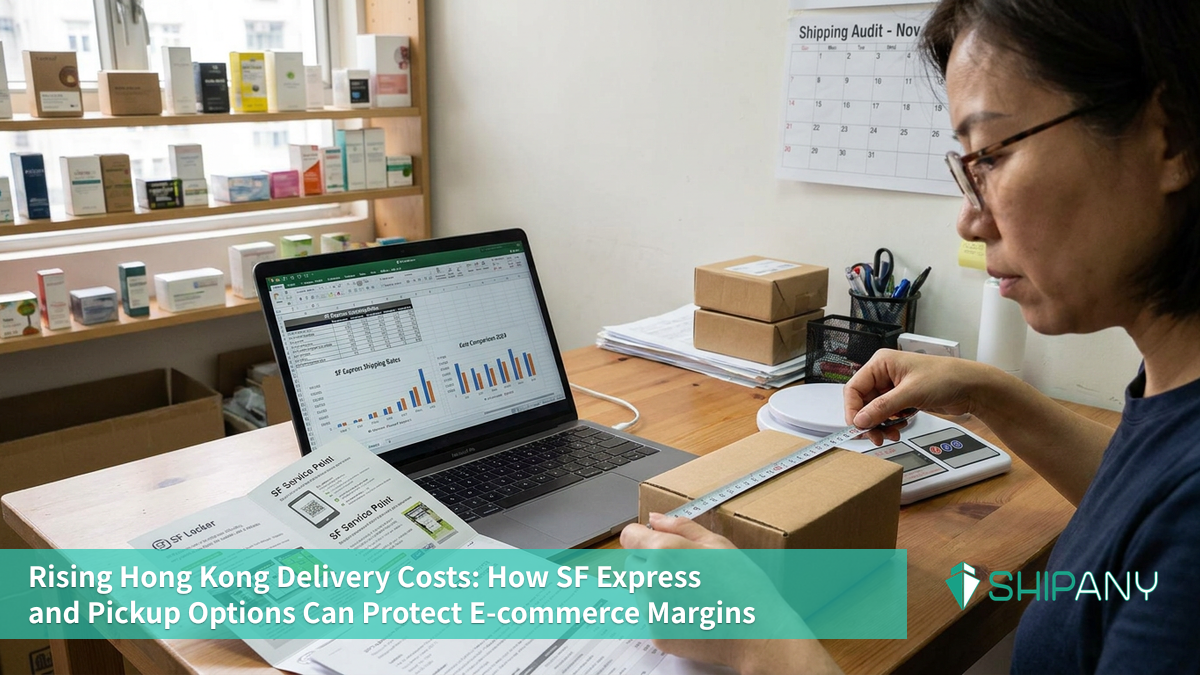
Build a representative basket of your own orders to compare. Include a compact skincare parcel going to an urban address, a larger apparel order and a heavier homeware shipment, then check the charge for each destination and delivery method. Record billed weight, surcharges and any extra handling separately. Look at the final cost by parcel type and postcode or area, not just the average. This helps reveal whether the pressure comes from a carrier rate change, a particular product’s packaging, or a service choice that is being used for orders that do not need it.
How can right-sized packaging reduce volumetric weight?
Choose packaging that protects the product without leaving avoidable empty space, because a large, light parcel may be charged according to its volumetric weight rather than its scale weight. Check the carrier’s current dimensional-weight formula and rounding rules for the service you plan to use; SF Express rate materials specify dimensional calculations, and the applicable method can vary by shipment type or destination. Measure the packed parcel, not just the product, and compare its actual and volumetric weight before making cost assumptions.
For example, a small bottle shipped in a deep box with generous void fill can take up more billed space than necessary. A correctly sized carton, paper cushioning or a suitable padded mailer may reduce dimensions while still preventing movement and breakage. Test changes with fragile products before rolling them out, and keep packaging standards for liquids, glass and other sensitive items. Review the most frequently shipped product combinations first: a small reduction in box dimensions across many weekly orders can be more useful than redesigning an occasional oversized parcel. Keep final packed dimensions in your product or packing records so staff can select materials consistently.
When should you offer SF Express lockers and pickup points?
Offer SF Express pickup when a customer can conveniently collect the parcel and the option fits the shipment’s size, weight and service eligibility. Hong Kong customers may be able to select SF Lockers, SF Stores or other designated SF pickup locations, subject to current availability and carrier rules. A locker can suit a compact parcel and a recipient who prefers self-service collection; a staffed store may be a better fit when the shipment cannot go into a locker or the customer wants a staffed location. Check the current location list, operating hours, parcel limits and collection period before enabling a point at checkout.
Pickup is not automatically the best option for every order. A customer may need to travel, carry the parcel home or collect it before a deadline; a locker may be full, inaccessible to some recipients or unsuitable for a bulky order. Tell shoppers how they will receive collection instructions and what happens if a parcel is not collected in time. Avoid implying that every location has the same hours or parcel capacity. Keep the choice clear at checkout, and confirm the exact delivery terms with SF Express before promoting a pickup service or promising a particular collection window.
How do you balance delivery speed, convenience and fulfilment cost?
Compare each shipping option across three measures: how quickly it is expected to arrive, how convenient it is for the recipient and what it costs your business to fulfil. Door delivery may be the right choice for a large order, a gift with a tight schedule or a customer who cannot reach a pickup point. Pickup can be a useful alternative for customers near an SF Locker or store who value flexibility, but the value depends on location, parcel eligibility and collection hours. Use carrier service estimates for planning, and avoid turning an estimate into a guaranteed delivery promise unless the service terms support it.
Create a simple shipping matrix for common orders: compact and light, bulky, higher value, and time-sensitive. For each, list eligible services, the live or contracted charge, typical delivery expectations, pickup availability and any important customer action. Then decide which options to show by default, which to offer as paid upgrades and which to exclude for certain parcel types. Track actual delivery performance, checkout selection, failed delivery or redelivery events and customer contacts. A cheaper label may not be the better business choice if it leads to repeated support work or an unhappy recipient.
How can ShipAny make a shipping mix easier to manage?
ShipAny can help Hong Kong merchants bring shipping tasks and options into a more manageable workflow, rather than relying on separate manual checks for every order. Depending on the services configured for your store, merchants can compare available shipping quotes, arrange waybills and manage delivery or pickup choices. That makes it easier to apply a consistent rule—for example, presenting eligible pickup options for compact parcels while keeping door delivery available for larger orders—and to review costs before fulfilment. Check the supported carriers and service coverage for your specific account and shipment requirements.
As order volume grows, recording parcel dimensions, service choice and actual shipping cost alongside order data can help identify where margin is leaking. ShipAny’s [Hong Kong logistics services] can be relevant when you are reviewing local courier, locker and pickup workflows; its [Shipping calculator] can help compare available quotes for shipment details you provide. Use those tools as part of a regular review, and verify final charges and service conditions with the carrier. The merchant still needs sensible packaging rules and clear checkout information: automation supports a shipping policy, but it does not replace one.
FAQ
Does SF Express charge Hong Kong parcels by size as well as weight?
SF Express may use volumetric weight for applicable services, so a large, light parcel can be billed differently from its scale weight. Check the current rate card and dimensional-weight rules for the exact service and destination, and measure the parcel after packing.
Can every Hong Kong order be delivered to an SF Locker?
No, SF Locker delivery depends on the parcel meeting current size, weight and service requirements, and on location availability. Check SF Express terms and the chosen locker’s details before offering it for a product or order.
Are SF Express pickup points always cheaper than home delivery?
Not necessarily; the charge depends on the service, shipment and current carrier pricing. Compare the actual quote and consider customer convenience, parcel eligibility and any collection or redelivery conditions before choosing a checkout price.
How often should a Hong Kong store review delivery costs?
Review carrier rate cards and surcharges whenever a carrier announces changes, and periodically compare actual invoices with your shipping rules. Recheck sooner if parcel dimensions, order mix, delivery areas or customer preferences have changed.
Conclusion
Protecting delivery margin in Hong Kong is a repeatable process: verify current charges, keep packaging dimensions under control and offer pickup only where it suits both the parcel and the customer. Compare speed, convenience and total fulfilment effort—not just the label price—then adjust the shipping mix as your order data changes.
A clear set of rules, supported by reliable quotes and accurate parcel data, helps your store make shipping choices with fewer surprises for both the business and the buyer.