
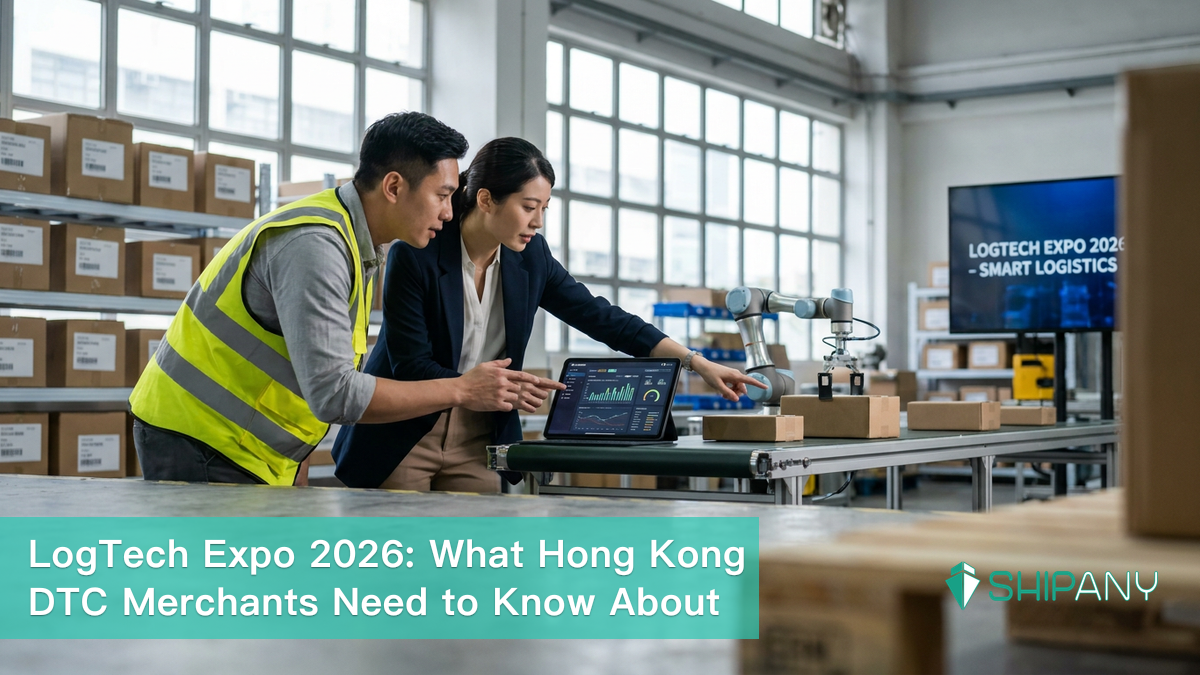
LogTech Expo 2026 gives Hong Kong DTC merchants a practical look at how AI, warehouse automation and connected logistics platforms could make fulfilment more reliable as order volumes grow. Organised by the Hong Kong Productivity Council (HKPC) and funded through the Logistics Promotion Funding Scheme under the Transport and Logistics Bureau’s Maritime and Aviation Training Fund, the Expo takes place on 29 October at InnoCentre in Kowloon Tong.
What should Hong Kong DTC merchants look for at LogTech Expo 2026?
The Expo is worth viewing as a working menu of logistics capabilities, not a promise that every new technology is ready to install in a small online store. HKPC says more than 50 logistics, supply-chain and technology enterprises will take part, with zones covering AI and data applications, smart warehousing and robotics, digital supply-chain platforms, cross-border e-commerce and delivery, ESG, and low-altitude logistics. Participating organisations named by HKPC include SF Supply Chain, Hongkong Post, Tradelink, GS1 Hong Kong, Axis Communications and ShipAny.
For a Hong Kong merchant, the most useful question is: which operational bottleneck would this solve? If staff spend too long copying orders into different courier portals, investigate workflow integration. If pickers repeatedly search for small items, examine warehouse location and scanning systems. If stockouts or overselling are common, ask how inventory data and demand forecasts connect to the store. This keeps the conversation grounded in everyday work rather than novelty.
The event is scheduled for 10:00 a.m. to 5:30 p.m. on Thursday, 29 October, at InnoCentre, 72 Tat Chee Avenue, Kowloon Tong. Its programme includes seminars on AI, cross-border e-commerce and digital supply chains. Merchants can bring a simple process map, recent order-flow examples and a list of recurring fulfilment problems to make discussions with exhibitors more specific.
How can warehouse automation help a Hong Kong online store?
Warehouse automation can reduce repetitive movement and handling when it is matched to the merchant’s product mix, order pattern and available space. The Expo’s smart warehousing and robotics zone is set to feature areas such as intelligent sorting, automated warehousing and robotics. For a local DTC brand, these ideas may be relevant whether stock is held in a compact Kwai Chung facility, a shared fulfilment centre or a larger warehouse serving Hong Kong Island and the New Territories.
Automation does not have to mean a fully robotic warehouse. Barcode or RFID scanning, clear bin-location rules, handheld picking prompts and automated sorting by courier or delivery service can address common errors first. For example, a skincare shop handling several similar-sized products could scan each item at picking and packing, then route completed parcels into separate collection areas for different couriers. That can make it easier to spot a wrong variant before a parcel leaves the building.
Before buying equipment or signing a warehouse contract, check whether it connects with your existing order and stock systems, what happens during a system outage, and how returns and exchanges are processed. Ask for a demonstration using a workflow close to your own, including fragile goods, bundles or pre-orders if those are part of your business. The right first step may be better process design and data capture, not a large capital investment.
How can AI improve inventory planning without replacing merchant judgement?
AI-driven inventory tools can help merchants spot demand patterns and make replenishment decisions earlier, but their recommendations are only as useful as the underlying data. The Expo’s AI and data zone focuses on using AI, big data and automation to improve logistics planning and operational efficiency. For a DTC seller, the practical application is to bring sales history, current stock, supplier lead times and promotion plans into a clearer view.
A Hong Kong brand preparing for a seasonal campaign might use those signals to identify which popular sizes or flavours are likely to run low, and which slower lines should not be reordered in the same quantity. A system may also flag unusual sales changes or inventory discrepancies. Merchants should still account for context the model may not understand, such as a one-off influencer mention, a supplier’s holiday closure or a planned product launch. Forecasts support decisions; they do not remove the need to check them.
When assessing a tool, ask how it handles returns, cancelled orders, bundles and stock held across multiple locations. Check whether it can synchronise inventory with your ecommerce platform and warehouse management system (WMS), and whether staff can see why a replenishment suggestion was made. Clean product identifiers, timely stock updates and agreed rules for safety stock often matter more than an impressive dashboard.
How do connected systems streamline courier workflows in Hong Kong?
Connected order, warehouse and transport systems can reduce manual courier administration by moving shipment information through one consistent workflow. The Expo’s smart supply-chain and digital-platform zone includes WMS, transport management systems (TMS) and digital supply-chain management. For a merchant, the practical goal is to avoid re-keying addresses, parcel details and tracking numbers between an online store, a packing team and separate courier portals.
A more integrated process can import paid orders, validate the delivery details, select an appropriate service, generate waybills and return tracking information to the store. Staff can then focus on exceptions: an incomplete address, a failed label request, a delivery preference that needs confirmation or a parcel awaiting collection. In Hong Kong, where customers may choose home delivery, a business address, a pickup point or a locker depending on the carrier’s options, accurate service and address data help reduce avoidable handoffs and customer queries.
ShipAny helps merchants bring courier tasks into a more manageable workflow, including comparing quotes, preparing waybills, arranging pickup and sharing tracking. Its [e-commerce delivery service](/en/e-commerce-delivery-service/) supports a one-stop shipping workflow, while [Hong Kong logistics services](/en/logistics-services-in-hong-kong/) cover local courier, locker and pickup options. The value is not simply fewer clicks: it is having a clearer view of which orders are ready, which have been handed to a carrier and which need attention.
How should a DTC merchant choose which logistics technology to adopt first?
Start with the step that creates the most cost, delay or customer frustration, then test technology against that specific problem. If packing errors dominate, improve item scanning and packing checks. If courier booking consumes staff hours, prioritise store-to-shipping integration. If popular products repeatedly run out, assess inventory visibility and replenishment planning before investing in warehouse robots. A focused pilot is easier to measure and less disruptive than replacing several systems at once.
Before implementation, map the systems involved: ecommerce platform, payment and order records, WMS, inventory tool, courier services and customer notifications. Confirm which system is the source of truth for stock and tracking, how often data syncs, and who resolves failed integrations. Merchants using Shopify or another store platform should verify that the proposed connector supports the functions they actually need, including partial fulfilment, returns and multiple parcels per order.
Set a baseline before the pilot: time from order to dispatch, picking accuracy, failed label rate, stock discrepancies and customer contacts about delivery. Review the results after a defined test period and include the staff who use the process every day. Expo demonstrations and seminars can help identify options, but local fit, implementation support, data quality and total operating effort should determine the decision.
FAQ
When and where is LogTech Expo 2026 in Hong Kong?
LogTech Expo 2026 is scheduled for Thursday, 29 October 2026, from 10:00 a.m. to 5:30 p.m. at InnoCentre, 72 Tat Chee Avenue, Kowloon Tong. HKPC says the event is free to attend, with public registration available.
What logistics technologies are featured at LogTech Expo 2026?
LogTech Expo 2026 features zones for AI and data applications, smart warehousing and robotics, digital supply-chain platforms, cross-border e-commerce and delivery, ESG and green logistics, and low-altitude logistics. HKPC also lists seminars and technical sharing on topics including AI, digitalisation and cross-border e-commerce.
Can a small Hong Kong DTC brand benefit from warehouse automation?
A small Hong Kong DTC brand can benefit from practical automation such as barcode scanning, clearer bin locations and sorting orders by courier. These measures can reduce repetitive work and picking mistakes without requiring a fully automated warehouse.
How can a merchant reduce manual courier work as orders grow?
A merchant can connect its online store and fulfilment process to tools that centralise courier selection, waybill creation, pickup arrangements and tracking updates. The merchant should check that the workflow supports its carriers, delivery options, order exceptions and returns.
Conclusion
LogTech Expo 2026 puts practical questions about AI, warehouse operations and connected delivery workflows on the agenda for Hong Kong merchants. The strongest opportunity is to identify one recurring fulfilment problem, see how a relevant technology addresses it, and test the improvement against real orders before scaling.
As competition and order volumes rise, reliable data and fewer manual handoffs can make the difference between simply shipping more parcels and delivering a consistently better customer experience.